Are You Making These Common Tourniquet Training Mistakes?
Joshua Soutullo Apr 09, 2026
Are You Making These Common Tourniquet Training Mistakes?
STATUS: CRITICAL IMPORTANCE OF HEMORRHAGE CONTROL
In a life-threatening bleeding situation, time is the only variable you cannot recover. A person can bleed out from a femoral artery wound in as little as three minutes. This reality is why tourniquet training has shifted from a specialized military skill to a fundamental necessity for first responders, teachers, and firearms enthusiasts alike.
At 2A Arms LLC, we see a lot of people buying high-quality gear. That is step one. But, step two is knowing how to use it. Carrying a tourniquet (TQ) without proper training is like carrying a firearm you’ve never fired, or a condom you never used: it provides a false sense of security that can vanish the moment things go south. Even for those who have taken a course, "skill rot" is real, take it from me. If you haven't practiced in six months, you are likely making one of the common mistakes we see in our classes—built around real-world trauma care and taught with the perspective of a seasoned Navy Hospital Corpsman.
This guide identifies the technical failures and mental hurdles that prevent effective tourniquet application. If you are serious about being a first responder in your community or keeping your family safe, audit your skills against these common errors.
PROTOCOL 01: IMPROPER PLACEMENT HEIGHT
One of the most frequent errors identified in medical training is placing the tourniquet too close to the wound.
Current medical protocols recommend applying the tourniquet approximately 2–3 inches (5–7 cm) above the wound source. Textbook answers aren't always the best, quickest, or easiest. If the wound is on a extremity (That's arms and legs in case you're wondering) and you aren't sure exactly where the bleeding is coming from (due to clothing or lighting), the "high and tight" method: placing the TQ as high as possible on the limb: is often the safest bet in a "care under fire" or high-stress situation.
However, in a controlled environment where the wound is visible, that 2-3 inch gap is considered the sweet spot. Why? Arteries are elastic. When they are completely severed, they can retract up into the limb. If you place the TQ right on the edge of the wound, the artery might have already snapped back past your compression point. This is why I train and stick with the "high and tight" approach. Because, why take the chance?
THE JOINT TRAP
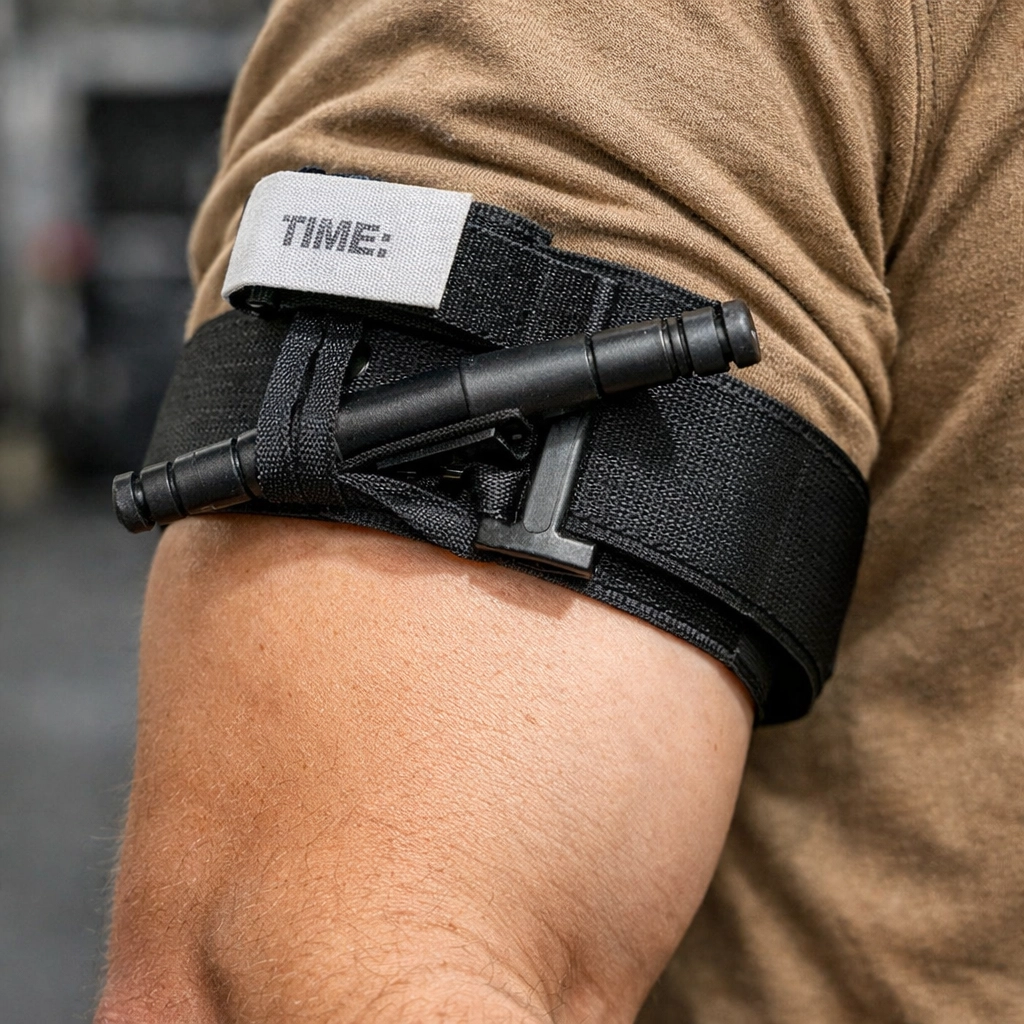
Another placement error is trying to apply a tourniquet directly over a joint, such as the knee or the elbow. I can hear some of you laughing but, I've seen people try this in training way too often. But, this is a mechanical failure. Joints are composed of bone and tough connective tissue that do not compress easily. Furthermore, the uneven surface of a joint creates gaps between the TQ strap and the skin. These gaps allow blood to continue flowing through the protected channels of the joint. Always move above the joint to a "single bone" area (the femur in the thigh or the humerus in the upper arm) to ensure the strap can exert even pressure all the way around the vessel.
PROTOCOL 02: THE SLACK FACTOR (THE #1 FAILURE)
If there is one thing "Doc" emphasizes in our training sessions, it’s this: You must pull the slack out before you touch the windlass.
The windlass is the plastic or metal rod you twist to tighten the TQ. Its job is to provide the final stage of mechanical advantage to shut down arterial flow. It is not designed to take up the 4-6 inches of loose strap you left hanging.
Most people are too "gentle" during the initial velcro stage. They wrap it around the arm or leg, stick the velcro down comfortably, and then start cranking the windlass. By the time the windlass is tight, they’ve run out of room to turn it, or the stitching on the internal band snaps because it’s being asked to do too much work.
The Two-Finger Rule:
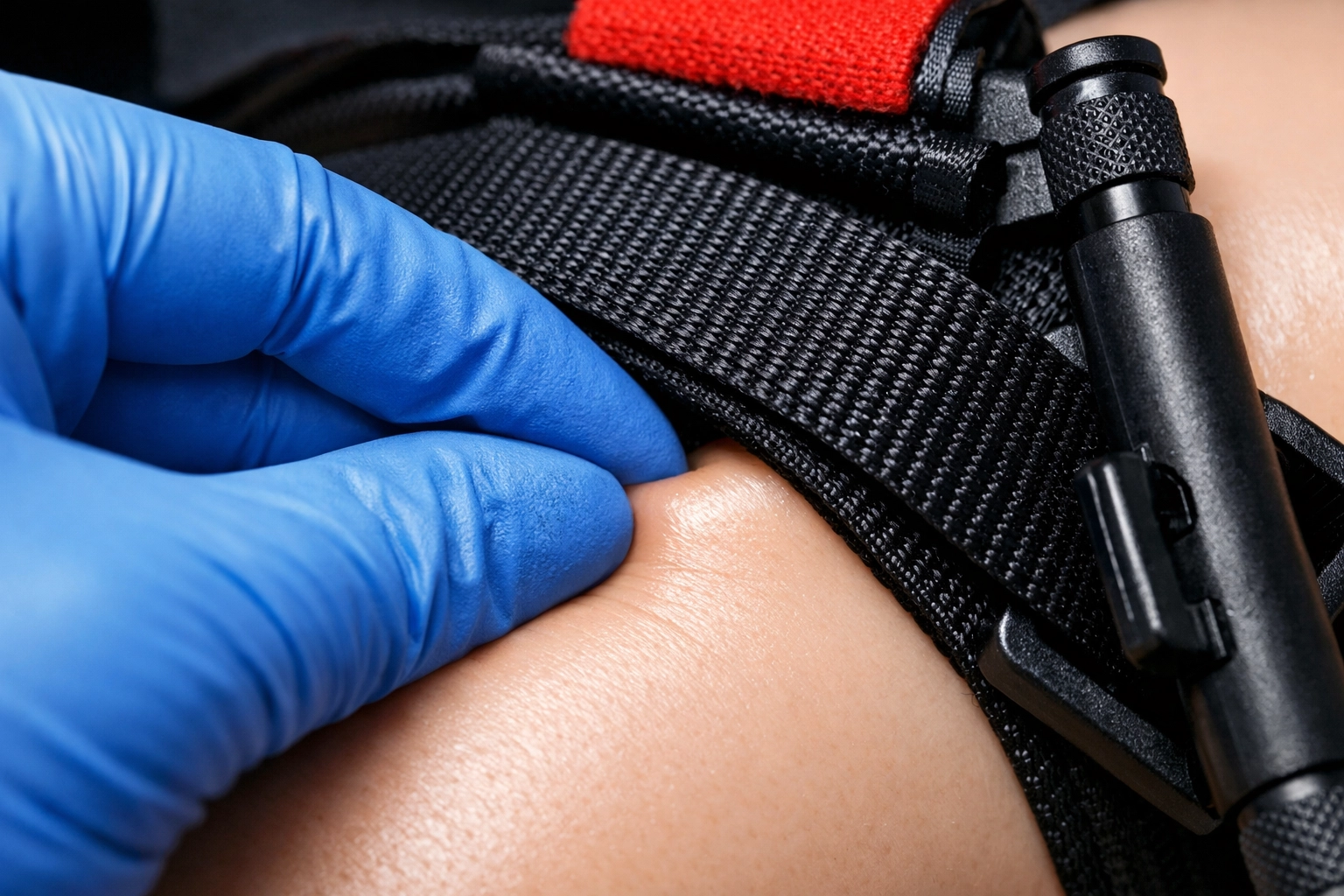
Before you ever turn the windlass, the strap should be so tight that you cannot easily slide two fingers underneath it. It should be uncomfortably tight from the velcro alone. If you do the "initial pull" correctly, you should only need 1 to 3 full turns of the windlass to stop the bleed. We only tighten until bleeding stops!!!
PROTOCOL 03: UNDERESTIMATING THE PAIN
This is a major hurdle for teachers and civilian bystanders. Applying a tourniquet correctly hurts. In fact, it hurts a lot. The victim will bein severe pain. This is normal! But remember, it's life over limb.
In a training environment, students often stop tightening the moment their "patient" (usually a classmate) starts complaining. In a real-life emergency, this hesitation can be fatal. If the tourniquet is not tight enough to stop the arterial flow, it might only be tight enough to stop venous return. This actually makes the bleeding worse because blood can get into the limb but can't get out, increasing the pressure at the wound site.
You must tighten the TQ until the bleeding stops and the distal pulse (the pulse further down the limb) is gone. If the patient is conscious, they will scream. You have to be mentally prepared to ignore those screams to save their life. This is why hands-on tourniquet training is so important: it gets you used to the physical resistance and the reality of the procedure.
PROTOCOL 04: RELIANCE ON IMPROVISED GEAR
We’ve all seen the movies where the hero uses a leather belt or a torn shirt to save someone. In the real world, this fails 99% of the time.
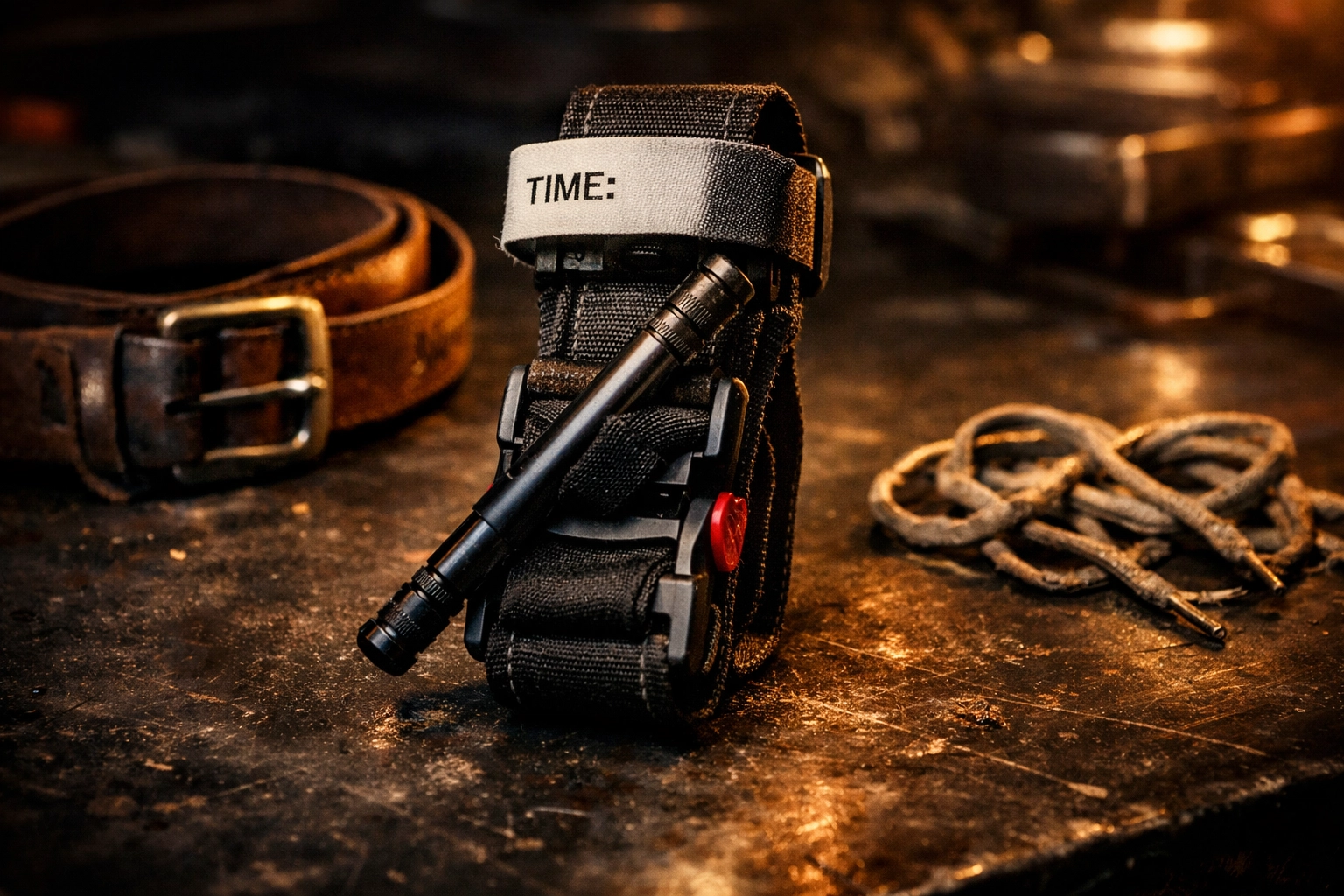
Research shows that improvised tourniquets rarely achieve the pressure necessary to stop arterial blood flow. A leather belt is too stiff and doesn't compress evenly; it also lacks a windlass mechanism, meaning you can't get it tight enough with hand strength alone. Thin materials like shoelaces or wire are even worse: they act like a cheese slicer, cutting through skin and muscle without actually stopping the deep-seated arterial bleed.
At 2A Arms LLC, we only recommend and sell CoTCCC (Committee on Tactical Combat Casualty Care) approved tourniquets, like the CAT (Combat Application Tourniquet) or the SOF-T. When you're in our store or browsing our site, we’ll show you the difference between the real deal and the cheap knock-offs you find on discount websites that snap the moment you put weight on the windlass. Sad to say, but, all TQ's are not built Ford tough.
PROTOCOL 05: POOR GEOMETRY AND ORIENTATION
The way you angle the tourniquet matters. A TQ should be applied horizontally (perpendicular to the limb). If it is applied at a diagonal angle, it is prone to sliding. As the patient is moved, loaded into an ambulance, or even just shifts in pain, a diagonal TQ can migrate toward the narrower part of the limb, instantly losing its tension and causing the bleeding to restart.
Additionally, pay attention to windlass orientation. You want the windlass in a position where you can easily reach it and where it won't be easily bumped loose or caught on clothing. This is important if the victim is conscious or becomes conscious and bumps your hard work of track...During one-handed application (applying it to yourself), this becomes even more critical. If you practice in a chair but never practice while lying on the ground, you might find that your favorite TQ placement is impossible to reach when you're actually down.
WHY TOURNIQUET TRAINING MATTERS FOR EVERYONE
You might think, "I'm a teacher, I don't need this." Or "I just go to the range, I'm careful."
The truth is that trauma doesn't care about your profession. Whether it's a car accident, a kitchen mishap, a power tool accident, or a worst-case scenario in a public space, the person best positioned to save a life isn't the surgeon at the hospital: it’s the person standing next to the victim with a tourniquet and the training to use it. Some of you have been lucky enough to never encounter a traumatic situation like this. Which, isn't a bad thing. But, you reading this means you at least want to be prepared if that time ever comes. Good on you!
For Teachers: You are the first responders for our children. Understanding how to manage a massive bleed in a classroom setting is just as important as fire drills.
For First Responders: You know the stakes, but when was the last time you ran a TQ drill under stress or with gloves on?
For Firearms Enthusiasts: If you are going to handle tools that can cause holes, you have a moral obligation to know how to fix those holes.
TAKE THE NEXT STEP WITH 2A ARMS LLC
Reading a blog post is a great start, but it isn't training. Muscle memory is what saves lives when the adrenaline is dumping and your fine motor skills disappear.
Joshua Soutullo and the team at 2A Arms LLC offer comprehensive hemorrhage control and trauma skills courses designed for every skill level, built on practical experience and Joshua’s background as a seasoned Navy Hospital Corpsman. We keep it simple, we keep it casual (top a point, there will be extreme simulated stress involved) and for good reason, but we also take the science very seriously and will make sure you are ready for that bad day. We will put a TQ in your hands, walk you through the common mistakes mentioned here, and make sure you leave with the confidence to act when it counts.
Don't wait for an emergency to realize you aren't ready. Check out our upcoming training schedule and gear up at our website. We will be linking the course calendar soon so become a member today to get notified when she drops. Classes start October 2026. We look forward to seeing you there!
SYSTEM SUMMARY:
- Placement: 2-3 inches above the wound; never on a joint.
- Slack: Remove all slack before turning the windlass.
- Tension: Tighten until bleeding stops, regardless of pain.
- Equipment: Use only CoTCCC approved tourniquets.
- Training: Knowledge is useless without practice.
Stay safe, stay trained, and be the help until the help arrives.